





Bitcoin isn’t just a store of value anymore. The question has shifted from “Why hold BTC?” to “What can I do with it?”
That shift is the start of BTCFi. A new era where Bitcoin can be used productively in DeFi, without giving up self-custody.
For years, BTC mostly sat idle or entered DeFi through centralised wrappers. That’s no longer the case. New infrastructure is making it possible to use native Bitcoin directly in DeFi, while keeping its core principles intact.
Babylon Genesis is at the centre of this shift. And with the launch, BTCFi finally has the home it needs to grow.
Making Bitcoin Productive Again
Babylon Genesis’ goal is simple: to build native use-cases for Bitcoin. It allows Bitcoin holders to stake BTC to secure Proof-of-Stake networks and earn rewards for it, all while keeping their BTC in self-custody, secured natively on the Bitcoin network.
Babylon Genesis calls these networks “Bitcoin Supercharged Networks” or BSNs, and it’s building a new marketplace where BTC provides security across many chains.
In August 2024, Babylon launched the Babylon Bitcoin staking protocol. Since then, over ~49,850 BTC, valued at approximately $5.52 billion USD, have been staked according to DeFiLlama, reflecting strong market interest.
Liquid staking protocols and custodians have already integrated with Babylon Genesis, and several PoS chains are preparing to tap into Bitcoin’s economic weight.
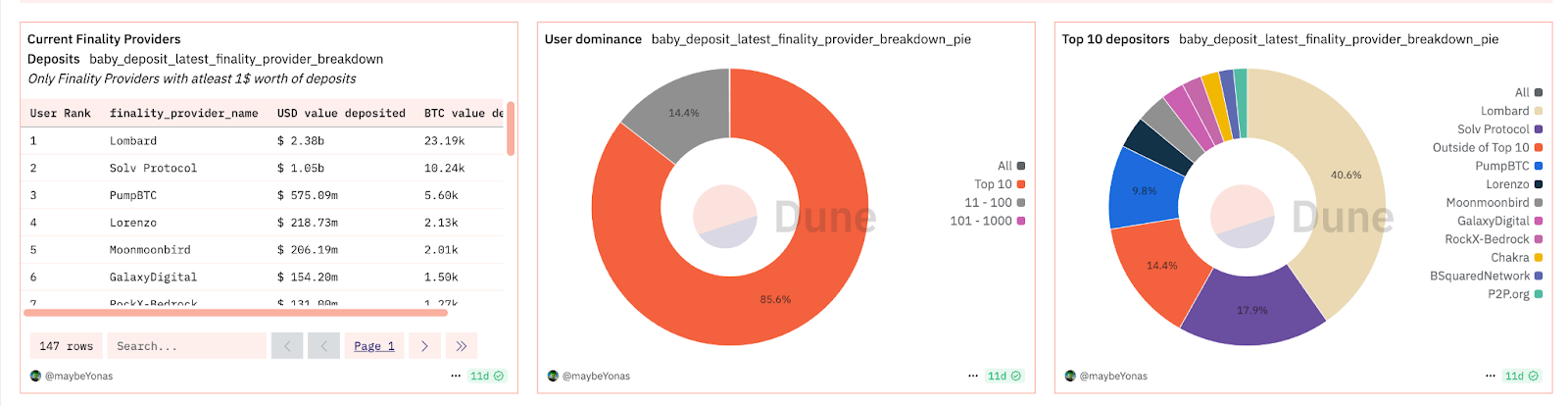
Source: https://dune.com/pyor_xyz/babylon-chain
Babylon Genesis Network
In April 2025, Babylon Genesis, a Layer 1 chain, launched as the first network secured by native Bitcoin staking. It uses timestamping to anchor its blocks to Bitcoin, bringing BTC’s security into a flexible PoS environment without ever removing BTC from its chain.
Babylon Genesis plays three key roles:
- A Bitcoin Supercharged Layer 1 where BTC backs network security
- A coordination layer for other chains to tap into Bitcoin
- A utility hub for BTC in DeFi, where DEXs and more can be built around native Bitcoin capital.
The implications are massive. Chains no longer have to rely solely on inflationary native tokens for security. Instead, they can tap into BTC’s $2T market cap. We’re already seeing projects take the BSN path, gaining early traction across major ecosystems.
Rewards on Bitcoin
Babylon Genesis introduces self-custodial BTC staking. No wrapping, or bridging, or third-party trust. You lock your BTC directly on the Bitcoin network, and it secures other Proof of Stake (PoS) chains, while earning you rewards.
As staking grows, liquid staking tokens (BTC LSTs) are emerging. These let users keep liquidity while their BTC earns rewards. These BTC derivatives are already being used across emerging DeFi protocols.
Retail and institutional players are both moving in. Wallets like BitGo and Anchorage now support BTC staking through Babylon Genesis. Tens of thousands of BTC are already getting used in Bitcoin-powered DeFi, and regulated frameworks are helping onboard even more capital. What was once a niche is quickly becoming mainstream.
Final Thoughts on BTCFi Adoption led by Babylon Genesis

Source: https://defillama.com/chain/bitcoin
There’s over $2T in BTC supply, and more than 99% is still idle. As users realise they can earn rewards while keeping full control of their Bitcoin, the incentive to stake grows. This creates a flywheel: more staked BTC leads to stronger networks and better DeFi opportunities, which in turn attract more BTC holders.
Babylon Genesis creates the ideal environment for BTCFi. It removes the old tradeoffs. No need to wrap BTC or trust third parties. Bitcoin can finally secure multi-chain DeFi while remaining on Bitcoin.
As more chains plug into Babylon Genesis and BTC-backed assets start flowing across ecosystems, BTCFi will stop being a niche narrative and become a foundational layer for DeFi.
About Babylon Labs
Babylon Labs focuses on Bitcoin supercharging-sharing protocols with a vision of building a Bitcoin-secured decentralized world. The latest software development is the world’s first trustless and self-custodial Bitcoin staking protocol, which enables Bitcoin holders to stake their BTC on other decentralized systems such as PoS chains, L2s, Data Availability (DA) layers, etc, enabling stakers to earn staking rewards without the need for third-party custody, bridge solutions, or wrapping services. The greater idea is to combine the high security and wide adoption of Bitcoin with the efficiency and scalability of PoS systems, increasing Bitcoin’s utility.
For more information about Babylon Labs, a developer of the Babylon Bitcoin staking protocol, please visit:
Website | Twitter | Discord | Linkedin
About Persistence One
Persistence One is building the BTCFi Liquidity Hub, enabling fast, near-zero-slippage swaps for BTC, BTC-variants, and LSTs on Persistence DEX.
BTCFi’s rapid growth has created multiple BTC-related assets, making fragmentation a big challenge. Persistence One will provide a single liquidity hub, simplifying value transfer across the Bitcoin ecosystem.
Twitter | LinkedIn | Telegram | YouTube | Reddit | [email protected]